

Introducing the Contextual Vulnerability Index: A New Framework for Understanding Children Beyond Outcomes
Why understanding context may be one of the most important challenges facing education

As school leaders, we spend much of our professional lives examining outcomes.
We monitor attendance.
We analyse attainment.
We review behaviour.
We track exclusions.
We discuss safeguarding concerns.
We identify SEND needs.
We evaluate interventions.
These activities are essential. They help us understand what is happening within our schools and provide the evidence upon which many of our decisions are based.
Yet over the past few years, I have found myself increasingly preoccupied by a different question.
How well do we understand the contexts that produce those outcomes?
Because while schools have become increasingly sophisticated at measuring what happens, I am not convinced we have become equally sophisticated at understanding why it happens.
That question became the starting point for the development of the Contextual Vulnerability Index (CVI).

The Challenge Schools Are Facing
Every school leader knows that children do not arrive at school as isolated data points.
They arrive carrying experiences.
Relationships.
Responsibilities.
Strengths.
Pressures.
Opportunities.
Adversities.
Some of these are visible.
Many are not.
Increasingly, schools are working with children whose lives are shaped by a complex interaction of factors that sit both inside and outside the school gates.
Housing instability.
Family breakdown.
Financial pressures.
Caring responsibilities.
Mental health challenges.
Poor attendance.
Social isolation.
Limited opportunities.
Low belonging.
Unmet developmental needs.
The challenge is not that schools fail to recognise these realities.
The challenge is that they are often considered separately.
Attendance in one meeting.
Behaviour in another.
Safeguarding in another.
SEND in another.
Pastoral support somewhere else.
Yet children experience these pressures simultaneously.
Their lives are interconnected.
Perhaps our understanding needs to become more interconnected too.
Why Develop the Contextual Vulnerability Index?
The Contextual Vulnerability Index was developed to address a gap that I increasingly believe exists within education.
Schools possess vast amounts of information.
What they often lack is a coherent framework for understanding how contextual pressures interact and influence children’s experiences.
The CVI is not intended to replace existing systems.
It is not designed to become another accountability measure.
It is not a diagnostic tool.
It is not a label.
Instead, it seeks to provide a structured way of understanding context.
At its heart sits a simple proposition:
If we want to improve outcomes, we must first improve understanding.
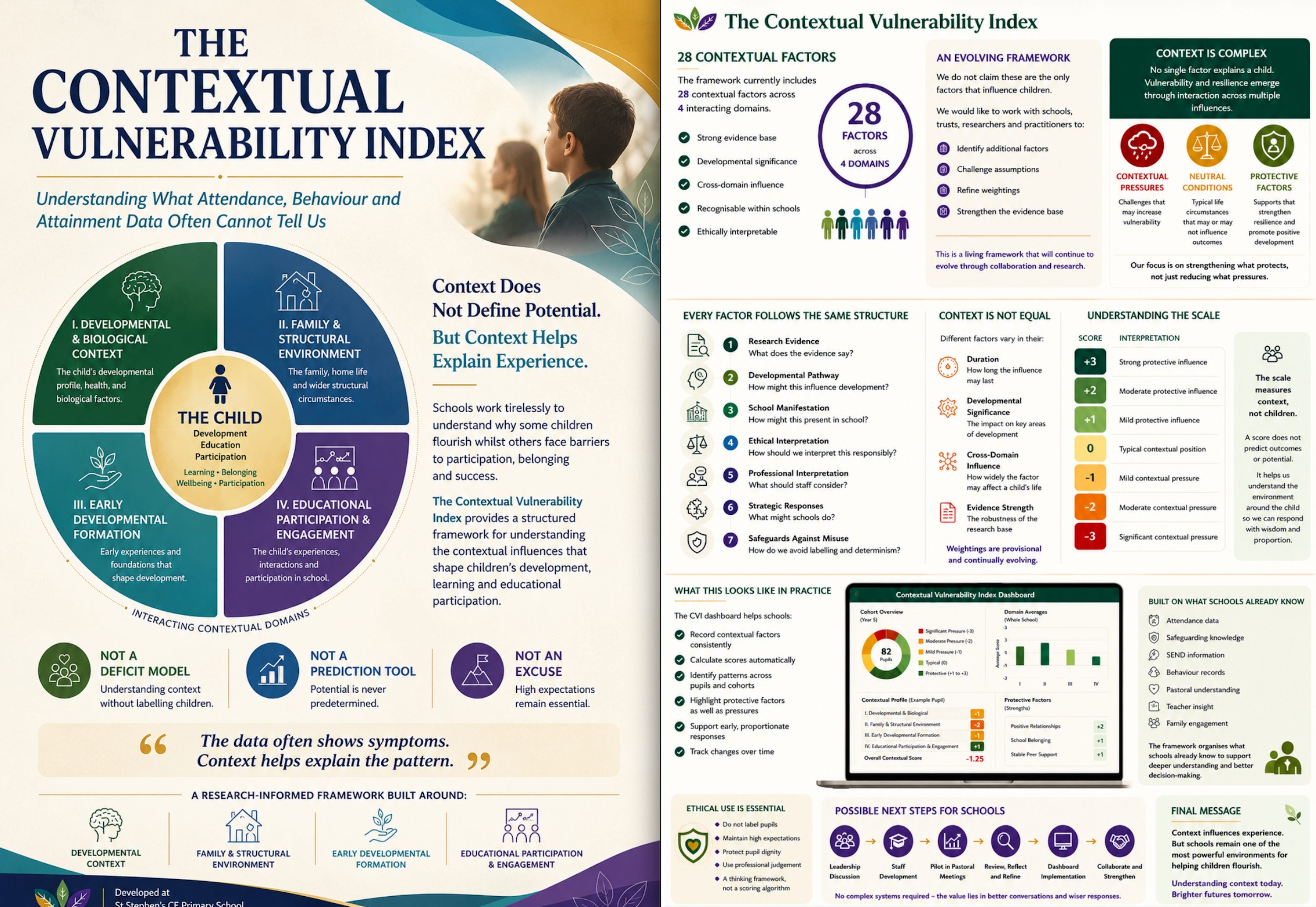
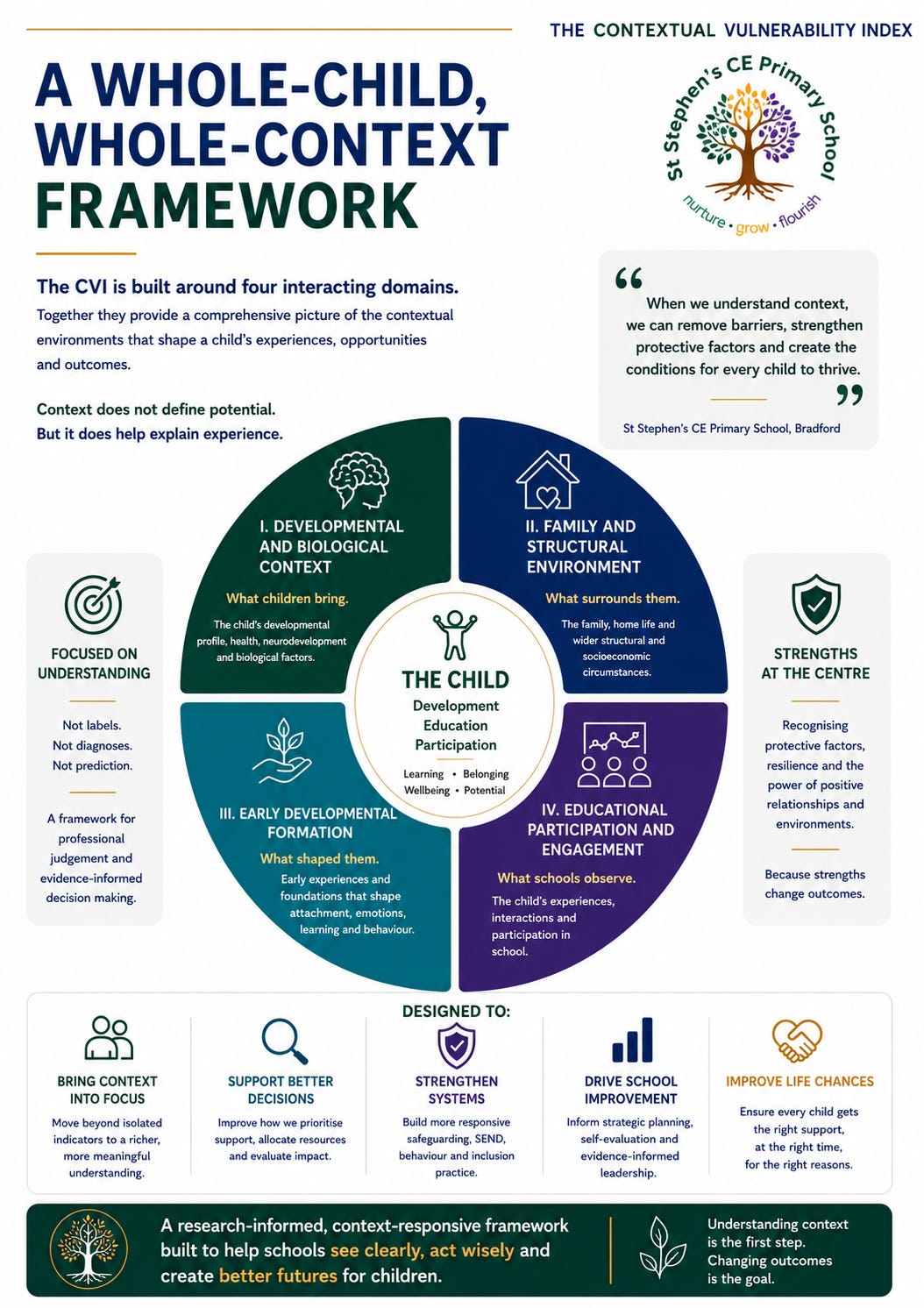
The framework brings together twenty-eight contextual vulnerability factors organised across four interconnected domains.
These domains explore children’s experiences across home, development, wellbeing, learning, participation, attendance, relationships and belonging.
Together they provide a richer picture of the environments within which children are growing, learning and developing.
Child Succeeding Despite Adversity
One of the most important ideas underpinning the framework is also one of the simplest.
Child succeeding despite adversity.
Most systems naturally focus on identifying children who are struggling.
The CVI deliberately asks a different question.
What about the child who appears to be thriving?
The child who attends regularly.
The child who achieves well.
The child who contributes positively.
The child who causes few concerns.
What if that child is also navigating significant adversity?
What if some of the most vulnerable children in our schools are hidden in plain sight?
Throughout the development of the framework, this pattern emerged repeatedly.
Children whose outcomes suggested success.
Children whose contexts suggested challenge.
Children who were succeeding not because adversity was absent, but because protective factors were present.
This became a defining principle of the CVI.
Understanding vulnerability is important.
Understanding protection is equally important.
Because vulnerability without protection provides only half the picture.
Looking Beyond Labels
One of my concerns with many approaches to vulnerability is that they can unintentionally become labels.
A child becomes known by a category.
A score.
A characteristic.
A deficit.
The CVI was designed to move away from that thinking.
Contextual vulnerability is not about defining children.
It is about understanding experiences.
It recognises that context influences development, participation and opportunity without determining outcomes.
Two children may experience similar challenges and respond very differently.
Two children may appear similar on paper while experiencing entirely different realities.
The framework seeks to encourage curiosity rather than assumption.
Professional discussion rather than simplistic categorisation.
Understanding rather than judgement.
More Than a Framework
The CVI is not simply a list of factors.
Every factor is explored through a structured seven-stage process:
Research Evidence
Developmental Pathways
School Manifestations
Ethical Interpretation
Professional Interpretation
Strategic Responses
Safeguards Against Misuse
This approach was intentional.
Too often frameworks identify issues without helping professionals think carefully about what those issues mean.
The CVI attempts to bridge that gap.
It encourages schools not only to identify contextual factors but also to explore how they should be understood, interpreted and responded to ethically.
In many ways, the framework is as much about improving professional thinking as it is about collecting information.
Why This Matters Beyond Education
Although the Contextual Vulnerability Index was developed within a primary school, the questions it raises extend far beyond education.
The framework sits at the intersection of:
Education
Psychology
Child Development
Public Health
Social Care
Safeguarding
Community Development
Each discipline contributes valuable insights into children’s lives.
Yet children experience all of these influences simultaneously.
Understanding context therefore requires us to think beyond traditional professional boundaries.
This is one of the reasons I believe the conversation surrounding the CVI has the potential to be much broader than education alone.
Help Me Prove It Wrong
The Contextual Vulnerability Index has now developed into:
A comprehensive framework
Twenty-eight contextual vulnerability factors
Protective factor measures
A data collection and moderation process
Leadership discussion tools
Implementation guidance
Conference materials
Ongoing school-based development
But no framework improves because its creator believes in it.
It improves because people challenge it.
Question it.
Test it.
Refine it.
If there are weaknesses within the framework, I want to find them.
If assumptions need challenging, I want to hear them.
If there are opportunities to strengthen the evidence base, I would welcome them.
That is why I am inviting engagement from:
Researchers
Headteachers
Trust leaders
Educational Psychologists
SEND specialists
Safeguarding professionals
Attendance experts
Social workers
Public health colleagues
Policymakers
Not because I am seeking endorsement.
Because I am seeking scrutiny.
The Bigger Question
The question is not whether attendance matters.
It does.
The question is not whether behaviour matters.
It does.
The question is not whether attainment matters.
It does.
The question is not whether safeguarding matters.
It does.
The question is whether we have become so focused on measuring outcomes that we sometimes overlook the contexts producing them.
If we want better outcomes, perhaps we need better understanding first.
That is the ambition behind the Contextual Vulnerability Index.
Not to predict a child’s future.
Not to define a child by their circumstances.
But to help schools, professionals and communities better understand the contexts within which children are living, learning and growing.
Because understanding context may be one of the most important educational conversations of the next decade.
And I believe we are only just beginning.
Below is a PowerPoint PDF explaining it. For more information please cdocontact me at paul.urry@ststephens.bradford.sch.uk
I haven't read it all yet but I love the idea and it's an impressive amount of thought and detail! I'm wondering if you have considered adding in the child's voice and opportunities for agency? It all seems based on teacher observation which is probably quite subjective. I'm also thinking student led goals might be more effective than high expectations because what are high expectations anyway? High for you might be low for me and vice versa.
This is a really important piece of work. The CVI addresses something I have thought about for a long time - we have become highly sophisticated at measuring what happens in schools, but far less sophisticated at understanding why. The concept of the child succeeding despite adversity is perhaps the most significant insight, because our systems are built to identify visible struggle, meaning the most vulnerable children are sometimes precisely those who appear to be coping. The question I would ask Paul is how we build the leadership culture needed to use a framework like this with the depth it deserves, rather than allowing it to become another data collection exercise.